


Next: 4.3.1 Non-overlapping elements
Up: 4. Basic routines
Previous: 4.2.2 Operations with sparse
Contents
4.3 Domain decomposition and basic numerical routines
The data distribution with respect to domain decomposition uses
geometrical connections for the parallelization.
The domain  will be split into
  subdomains
  (
(
![$ \scriptstyle i=\overline{1,P} \makebox[0pt]{}$](img373.gif) ), whose will be mapped on a process.
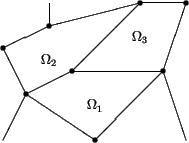
Fig. 4.4 presents an part of a non-overlapping domain decomposition.
We denote edges between subdomain as Interfaces.
The overlapping domain decomposition is not the main scope of that chapter.
), whose will be mapped on a process.
Fig. 4.4 presents an part of a non-overlapping domain decomposition.
We denote edges between subdomain as Interfaces.
The overlapping domain decomposition is not the main scope of that chapter.
Figure 4.4:
Non-overlapping domain decomposition.
 |
Concerning the data type we distinguish between element based and node based
data, which we may store overlapping or non-overlapping
(Domains are still non-overlapped!).
This leads to 4 types of data distributions - we will investigate the
non-overlapping distribution of (finite) elements in detail.
We regard matrices which have been generated by
Finite Element Methods (FEM),
Finite Difference Methods (FDM) or Finite Volume Methods (FVM).
Subsections
Gundolf Haase
2000-03-20