is split into 4 subdomains
each of them was discretized by linear triangular finite elements,
see Fig. 4.5.
is split into 4 subdomains
each of them was discretized by linear triangular finite elements,
see Fig. 4.5.
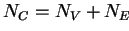
We distinguish between 3 sets of nodes denoted by the appropriate subscripts :
 ],
],
 ],
],
 ].
].
 ].
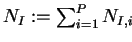
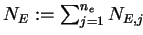
The total number of nodes is
].
The total number of nodes is
 .
.
For simplification purposes we number first the cross points then the edge nodes and at last the inner nodes. The nodes of one edge possess a sequential numbering, the same holds for the inner nodes of each subdomain so that all vectors and matrices have a block structure like

According to the mapping of nodes to the  subdomains
![$ \overline{\Omega} \makebox[0pt]{}_i$](img382.gif)
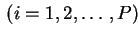 ,
all entries of matrices and vectors are distributed on the appropriate
process
,
all entries of matrices and vectors are distributed on the appropriate
process
 .
The coincidence matrices
.
The coincidence matrices  (
(
![$ \scriptstyle i=\overline{1,P} \makebox[0pt]{}$](img373.gif) )
represent this mapping.
In detail, the
)
represent this mapping.
In detail, the
 matrix is a boolean matrix
which maps the global vector
matrix is a boolean matrix
which maps the global vector
 onto the local vector
 .
.
Properties of A :
|
- Entries for inner nodes appear exactly once per row an column.
- Entries for coupling nodes appear once in if this node belongs
to process
.
|
Now, we define 2 types of vectors - the accumulated vector (type I) and the distributed vector (type-II) :
| Type I | : |
 und und are stored in process are stored in process
 (
(
![$ \;\hat{=}\;\overline{\Omega} \makebox[0pt]{}_i\;$](img392.gif) ) in the ways ) in the ways
 and
and
 ,
i.e., each process
owns the full values of that vector. ,
i.e., each process
owns the full values of that vector. |
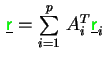
| Type II | : |
 are stored in the way are stored in the way
 in
such that in
such that
 holds,
i.e., each node on the interface ( holds,
i.e., each node on the interface (
 )
owns only a its contribution
to the full values of that vector. )
owns only a its contribution
to the full values of that vector. |
 is stored in a distributed way, analogously to a type-II
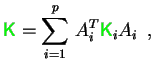
vector, and will be classified as type-II matrix :
is stored in a distributed way, analogously to a type-II
vector, and will be classified as type-II matrix :
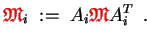
 denoting the stiffness matrix belonging to
subdomain
(to be more exact: the support of the
f.e. test functions is restricted to
).
If one thinks of
as one large finite element then
the distributed storing of the matrix is equivalent to the presentation
of that element matrix previously to the f.e. accumulation.
denoting the stiffness matrix belonging to
subdomain
(to be more exact: the support of the
f.e. test functions is restricted to
).
If one thinks of
as one large finite element then
the distributed storing of the matrix is equivalent to the presentation
of that element matrix previously to the f.e. accumulation.
 :
:

 is a block diagonal matrix with
entries
is a block diagonal matrix with
entries
 - similar block structures are valid for
 ,
,
 ,
,
 ,
,
 .
.
If we really perform the global accumulation of matrix
 then the result is a type-I matrix
 and we can write
 holds,
we have to distinguish between both representations because of
the different local storing (
holds,
we have to distinguish between both representations because of
the different local storing (
 ) !
) !
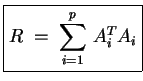
The diagonal matrix
![$ R^{[k]}:=4$](img415.gif) ,
,
![$ R^{[n]}=R^{[m]}=R^{[p]}=2$](img416.gif) ,
, ![$ R^{[q]}=1$](img417.gif) .
.
![$ {\ensuremath{\color{green}{\sf v}}}_{C,i}^{[n]}$](img418.gif) denotes the
denotes the
 component
(in local or global numbering) of vector
component
(in local or global numbering) of vector
 stored in
process
.
Subscript ''
stored in
process
.
Subscript '' '' indicates a subvector belonging to the interface.
A similar notation is used for matrices.
'' indicates a subvector belonging to the interface.
A similar notation is used for matrices.
![\begin{figure}\unitlength0.075\textwidth
\savebox{\subdomain} {
\thinlines
\...
...rrow$ ''I''}}
%
\par\end{picture} \ [2ex]
\end{center} \protect\end{figure}](img375.gif)