


Next: 4.3.1.3 Inner product.
Up: 4.3.1 Non-overlapping elements
Previous: 4.3.1.1 Generation of stiffness
Contents
4.3.1.2 Change of vector types
Obviously, we can apply addition/substraction and similar operations
without communication on vectors of the same type.
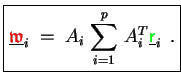
The conversion of type II (distributed) vector into a type I (accumulated)
vector requires communication :
 |
(4.4) |
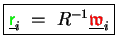
The other direction, conversion of a type-I vector into a type-II vector
is not unique.
One possibility consists in dividing locally each vector component by
its priority (number of subdomains a node belongs to), i.e.,
 |
(4.5) |
with  defined in (4.4).
Gundolf Haase
2000-03-20