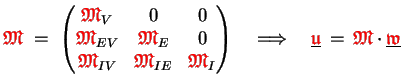
type-I vector results in a type-II vector.
type-II vector needs a
conversion of the vector previously to the multiplication
in item 1.
type-I vector cannot be performed with
arbitrary type-I matrices
type-I vector results in a type-II vector.
type-II vector needs a
conversion of the vector previously to the multiplication
in item 1.
type-I vector cannot be performed with
arbitrary type-I matrices
 .
.
 on node
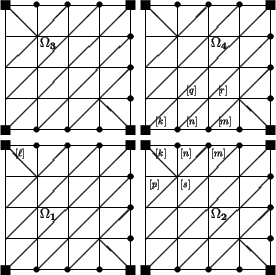
  in Fig. 4.5.
The local multiplication
in Fig. 4.5.
The local multiplication
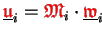 should result in a type-I vector
 at node in
both subdomains.
at node in
both subdomains.
![\begin{eqnarray*}
{\ensuremath{\color{red}\mathfrak{u}}}_2^{[n]} &=& {\ensurema...
...k{M}}}_4^{[n,r]}{\ensuremath{\color{red}\mathfrak{w}}}_4^{[r]}
\end{eqnarray*}](img431.gif) Terms 4 and 5 of the right hand side in the above equations differ
such that processes 2 and 4 achieve different results instead of
a unique one.
The reason consists in the transport of information via the matrix
from a process
Terms 4 and 5 of the right hand side in the above equations differ
such that processes 2 and 4 achieve different results instead of
a unique one.
The reason consists in the transport of information via the matrix
from a process  to a node belonging additionally
to another process
to a node belonging additionally
to another process  .
.
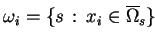 the
processors a node
the
processors a node  belongs to, e.g. in Fig. 4.4,
 ,
,
 ,
,
 .
Then, the transport of information from node
.
Then, the transport of information from node  to a node is
only admissible if
to a node is
only admissible if
 .
Representing the matrix entries as directed graph then,
e.g., in Fig. 4.4 the entries
.
Representing the matrix entries as directed graph then,
e.g., in Fig. 4.4 the entries
 ,
,
 ,
,
 ,
,
 ,
,
 ,
,
 ,
,
 ,
,
 ,
,
 ,
,
 ,
,
 are not admissible.
Thus, just a matrix of the shape
are not admissible.
Thus, just a matrix of the shape
 ,
,
 ,
,
 omits such forbidden entries.
Whereas the block-diagonality of
and the block structure of
omits such forbidden entries.
Whereas the block-diagonality of
and the block structure of
 ,
,
 is guaranteed by the
data decomposition, for the remaining three matrices the mesh has to
fulfill the requirements
(often
is a diagonal matrix).
No connection between vertices and opposite edges, e.g. in
Fig. 4.4,
is guaranteed by the
data decomposition, for the remaining three matrices the mesh has to
fulfill the requirements
(often
is a diagonal matrix).
No connection between vertices and opposite edges, e.g. in
Fig. 4.4,
 .
This ensures the admissible structure of
.
This ensures the admissible structure of
 (and
(and
 ).
.
).
.
 and is omitted.
Fig. 4.6 presents the revised mesh.
and is omitted.
Fig. 4.6 presents the revised mesh.
 This strategy can be applied only to triangular or
tetrahedral finite elements.
In general, rectangular elements do not
fulfill condition 3b.
type-II vector
cannot
be performed with general type-I matrices
. As result we
would expect a type-II vector.
This strategy can be applied only to triangular or
tetrahedral finite elements.
In general, rectangular elements do not
fulfill condition 3b.
type-II vector
cannot
be performed with general type-I matrices
. As result we
would expect a type-II vector.
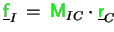 .
Performing this operation
locally on processor 4 gives
.
Performing this operation
locally on processor 4 gives
![$\displaystyle {\ensuremath{\color{green}{\sf f}}}_4^{[r]} \;=\; {\ensuremath{\c...
...M}}}_{IC,4}^{[r,m]}\cdot{\ensuremath{\color{green}{\sf r}}}_4^{[m]} \enspace .
$](img459.gif)
![$ {\ensuremath{\color{red}\mathfrak{M}}}_{IC,2}^{[r,n]}\cdot{\ensuremath{\color{green}{\sf r}}}_2^{[n]}$](img460.gif) and
and
![$ {\ensuremath{\color{red}\mathfrak{M}}}_{IC,2}^{[r,m]}\cdot{\ensuremath{\color{green}{\sf r}}}_2^{[m]}$](img461.gif) .
The difference to the previous point is that the transport
of information from node to a node is permitted only if
.
The difference to the previous point is that the transport
of information from node to a node is permitted only if
 .
Thus, just a matrix of the shape
,
,
can be used in this type of matrix-by-vector
multiplication.
,
,
are block-diagonale matrices (guaranteed by the mesh in Fig. 4.6).
Denote with
.
Thus, just a matrix of the shape
,
,
can be used in this type of matrix-by-vector
multiplication.
,
,
are block-diagonale matrices (guaranteed by the mesh in Fig. 4.6).
Denote with
 ,
,
 and
and
 the strictly lower,
upper and diagonal part of
. Then, we can perform the type I matrix-by-vector
multiplication for all types of vectors
the strictly lower,
upper and diagonal part of
. Then, we can perform the type I matrix-by-vector
multiplication for all types of vectors
If the Matrix
has been factored as
 with the lower and an upper triangular
matrices
with the lower and an upper triangular
matrices
 and
and
 , which fulfill
conditions 3 and 4, then
we write
, which fulfill
conditions 3 and 4, then
we write
 results in
.
results in
.