


 ,
,
 and state variables
 ,
,
 but also with
vectors
but also with
vectors
![$ \{z_i\}_{i=\overline{1,k+1} \makebox[0pt]{}}$](img512.gif) ,
,
![$ \{s_i\}_{i=\overline{1,k+1} \makebox[0pt]{}}$](img513.gif) ,
,
![$ \{c_i\}_{i=\overline{1,k+1} \makebox[0pt]{}}$](img514.gif) and matrix
and matrix
![$ \{h_{i,j}\}_{i,j=\overline{1,k} \makebox[0pt]{}}$](img515.gif) which do not fit in that scheme.
Therefore, we will handle them just as scalar values in the
parallelization.
which do not fit in that scheme.
Therefore, we will handle them just as scalar values in the
parallelization.
Our strategy for parallelization of the GMRES without
preconditioning ( ) is the following.
,

 ,
,
 are
distributed stored.
,
are
distributed stored.
,
 ,
,
 are
accumulated stored.
,
,
and
redundantly on each processor.
are
accumulated stored.
,
,
and
redundantly on each processor.

 includes one
change of the vector type via accumulation (4.5).
Here we need communication between all the processes
sharing the proper data.
includes one
change of the vector type via accumulation (4.5).
Here we need communication between all the processes
sharing the proper data.
 ,
,  ,
,  and
and  will be performed locally on each processor.
These operations are redundant.
will be performed locally on each processor.
These operations are redundant.
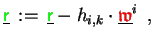
 into a distributed one
can be done without any communication (4.6) !
into a distributed one
can be done without any communication (4.6) !
![\begin{algorithmus}
% latex2html id marker 15107
[H]
\caption{Parallel GMRES} $ ...
...nderline{{\ensuremath{\color{red}\mathfrak{w}}}}^j
\end{array}$\end{algorithmus}](img524.gif)
 iteration of algorithm 5.4
includes
iteration of algorithm 5.4
includes  ALL/SMALL>_REDUCE-operations with one real number
and one vector accumulation.
Due to changing the type of vector
we have to perform
ALL/SMALL>_REDUCE-operations with one real number
and one vector accumulation.
Due to changing the type of vector
we have to perform
 additional multiplications (
 - length of vector
 ).
).
Parallelization of GMRES(m) with a restart after  iterations
can be done in the same way as above.
iterations
can be done in the same way as above.