


 (
(
 ) one can use
the General Conjugate Residual Method.
If is additionally not positive definite,
i.e.,
) one can use
the General Conjugate Residual Method.
If is additionally not positive definite,
i.e.,
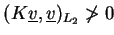 ,
then a variety of methods like GMRES, QMR, Bi-cg, Bi-cgstab
are available.
,
then a variety of methods like GMRES, QMR, Bi-cg, Bi-cgstab
are available.
![\begin{algorithmus}
% latex2html id marker 14942
[H]
\caption{Sequential GMRES w...
...}^0 + \sum\limits_{i=1}^k z_i\cdot \underline{w}^j
\end{array}$\end{algorithmus}](img507.gif)
 and
entries in matrix
and
entries in matrix
![$ H=\{h_{i,j}\}_{i,j=\overline{1,k} \makebox[0pt]{}}$](img509.gif) increases with the
number of iterations
increases with the
number of iterations  and may cause a memory overflow.
To prevent this unexpected termination of the iteration
the REPEAT-loop will be stopped after
and may cause a memory overflow.
To prevent this unexpected termination of the iteration
the REPEAT-loop will be stopped after  iterations and restarted
with
iterations and restarted
with
 as initial solution.
This shortening of the cycle leads to an unstable behavior of the
method.
as initial solution.
This shortening of the cycle leads to an unstable behavior of the
method.
For preconditioning techniques see section 5.8.