


 will be factored into an upper
![$ \widetilde{U} \makebox[0pt]{}$](img585.gif) and and lower triangular
matrix
and and lower triangular
matrix
![$ \widetilde{L} \makebox[0pt]{}$](img586.gif) .
The solving of the resulting graduated system of
equations with the triangular matrices is fast but the time for
the factorization
.
The solving of the resulting graduated system of
equations with the triangular matrices is fast but the time for
the factorization
 .
If the matrix is sparse (FEM, FDM, ...) then the fill-in in the
factorization blows up the memory requirements
for storing the factored matrix dramatically.
.
If the matrix is sparse (FEM, FDM, ...) then the fill-in in the
factorization blows up the memory requirements
for storing the factored matrix dramatically.
Therefore, one tries to factor matrix into
triangular matrices  and
and  with the same matrix pattern as .
Equation (5.4) has to be modified by taking the rest matrix
with the same matrix pattern as .
Equation (5.4) has to be modified by taking the rest matrix  into account.
The factorization  or
or  , respectively,
can be used in a simple iteration for approximating the defect
(e.g., replace
, respectively,
can be used in a simple iteration for approximating the defect
(e.g., replace  in the Jacobi iteration).
There exist special modifications for symmetric and positive definite matrices (ICC= Incomplete Cholesky) and for factorizations allowing a certain fill-in in the pattern of the triangular matrices (ILU(m)). They are often used in combination with lumping techniques, i.e., entries not fitting in the admissible pattern are added to the main diagonal (e.g., MAF).
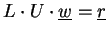
We investigate in the following the incomplete
factorizations (5.5) for non-symmetric matrices without
fill-in, i.e. the classical ILU(0) factorization, and the
appropriate elimination step
 .
.
![$\displaystyle K \;\;=:\;\; \widetilde{L} \makebox[0pt]{} \cdot \widetilde{U} \makebox[0pt]{} \enspace,$](img587.gif)
