


 -dimensional hypercube possesses exactly
  nodes.
will be constructed by
the appropriate union of two hypercubes with dimension
nodes.
will be constructed by
the appropriate union of two hypercubes with dimension  .
.
 and
and  are connected via link
  in a 3-dimensional hypercube.
-dimensional hypercube in 2
in a 3-dimensional hypercube.
-dimensional hypercube in 2  -dimensional hypercubes.
Depending on the fact whether the bit is set or not,
all nodes are mapped to one of the two subcubes, e.g.
in Fig. 2.6, link 2 divides the 3-dimensional hypercube
into the subcubes
-dimensional hypercubes.
Depending on the fact whether the bit is set or not,
all nodes are mapped to one of the two subcubes, e.g.
in Fig. 2.6, link 2 divides the 3-dimensional hypercube
into the subcubes
 and
and
 .
links per node.
.
links per node.

 and
and  can be calculated by XOR(,) , wherein the
not-cleared bits determine the links used in that path.
can be calculated by XOR(,) , wherein the
not-cleared bits determine the links used in that path. 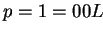 ,
,
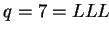
 XOR(,
XOR(, )
)  nodes can be defined recursively
and can be embedded in the hypercube :
nodes can be defined recursively
and can be embedded in the hypercube :
![\begin{algorithmus}
% latex2html id marker 1509
[H]\caption{Embedding of a ring ...
...{\makebox(0,0)[l]{ Reflection }}
\end{picture}\hfill\mbox{}\\
\end{algorithmus}](img94.gif)
Map a
 torus into a
( torus into a
( )-dimensional hypercube. )-dimensional hypercube.
|
Visualize by means of a 3d hypercube that the optimal tree
(Sec. 2.2.5) with node  as root is embedded therein.
How many mappings are possible ? as root is embedded therein.
How many mappings are possible ?
|
Determine an embedding of an optimal tree with root  onto a 3d hypercube.
|
| Find a simple function which maps the node numbers from E2.2 onto those of E2.3. |
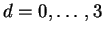
![\begin{figure}\unitlength0.04\textwidth
\begin{picture}(25,15)
\savebox{\opbox...
...makebox(0,0)[br]{$\scriptstyle 3$}}
\thinlines %
\par\end{picture}\end{figure}](img88.gif)
![\begin{figure}\unitlength0.03\textwidth
\begin{center}
\begin{picture}(11,11)(...
...r]{$\scriptstyle 3$}}
\thinlines %
\par\end{picture} \end{center} \end{figure}](img95.gif)