


Next: 2.2.6 The Hypercube
Up: 2.2 Topologies
Previous: 2.2.4 Array and Torus
Contents
2.2.5 The Tree
The tree
is a quite flexible topology with
good communication properties.
Optimal tree :
An optimal tree is a tree with maximal depth and maximal number of
branches at a node not larger than
 .
.
In the remaining lecture we will use the notation tree always in the sense of
an optimal tree.
Thus, for those trees the following statements are valid :
-
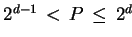
- Max.
 links per node.
- Diameter:

Figure 2.5:
Optimal tree in binary representation
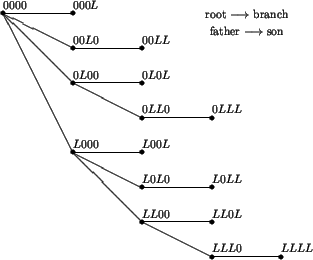 |
The numbering of nodes in the binary tree bases on the Gray code.
Gray code :
The binary representations of the numbers of neighboring nodes
differ in exactly one bit (
![$ [0,\ldots,d]$](img77.gif) ) !
) !
Construction of a binary tree
Each node in a tree with node  as root
possesses as much branches as 0-bits follow the last
as root
possesses as much branches as 0-bits follow the last  -bit
in its binary representation.
-bit
in its binary representation.
Hardware: Convex-MPP
with the concept of ''Fat Trees'', i.e.,
if a link is located closer to the root, then its
bandwidth will be higher.
Next: 2.2.6 The Hypercube
Up: 2.2 Topologies
Previous: 2.2.4 Array and Torus
Contents
Gundolf Haase
2000-03-20