which requires only a
constant small number of links per node.
which requires only a
constant small number of links per node.
 ISHFTC(
 )
(called Link 1)
)
(called Link 1)
 ISHFTC(
 )
(called Link 2)
)
(called Link 2)
 IOR(ISHFTC(),
 )
(Link 3)
)
(Link 3)
![\begin{figure}\unitlength0.06\textwidth
\begin{picture}(14,4)
\put(0,1){\line(...
...,1.5){\makebox(0,0){$\overline{b_d} \makebox[0pt]{}$}}
\end{picture}\end{figure}](img107.gif) IOR(ISHFTC(
),)
(Link 4)
IOR(ISHFTC(
),)
(Link 4)
 possesses
  nodes and
  (directed) edges.
 , has exactly 4 links.
Nodes 0 and need only 2 links, the remaining links
can be used for communication with the outer world.
, has exactly 4 links.
Nodes 0 and need only 2 links, the remaining links
can be used for communication with the outer world.
 Graph can be passed through without overlap.
Ring is embedded.
.
Graph can be passed through without overlap.
Ring is embedded.
.
For which nodes
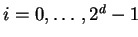 in a
de Brujin network the following relations hold ? in a
de Brujin network the following relations hold ?
Hint: Differentiate whether is even or odd.
|
Represent a de Brujin network with  ! !
|
|
Prove that the diameter in a de Brujin network
is equal to the dimension !
|
 : 8 nodes, 14 edges
![\begin{figure}\unitlength0.045\textwidth
\begin{picture}(24,6.5)
% Box [-1,1]x[...
...(0,0)[l]\{ underline\{$d=3$ :\} 8 nodes, 14 edges\}\}
\end{picture}\end{figure}](img111.gif)