Next: 7.1.3.3 Parallel pressure correction
Up: 7.1.3 Steps to the
Previous: 7.1.3.1 Data distribution
Contents
7.1.3.2 Parallel fix point iteration
All submatrices in (7.4) are distributed ones
(see section 4.3.1).
So, defining all state variables
 ,
,
 as accumulated vectors and all
integral variables / functionals
as accumulated vectors and all
integral variables / functionals
 (
(
 ,
,
 ) as distributed vectors is again obvious.
![\begin{algorithmus}
% latex2html id marker 30335
[H]
\caption{Linear implicit f...
...suremath{\color{red}\mathfrak{p}}}}^{n+1} \end{pmatrix}
$\\
\end{algorithmus}](img934.gif)
Here,
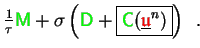
- Parts of the algorithm which require communication are marked by
 or the accumulation sum
 .
.
- In the inner product, a change of the type
for the accumulated vectors
 and
and
 is necessary.
This can be done without communication (4.6).
is necessary.
This can be done without communication (4.6).
If element types (a) or (c) with distribution of
macro elements are used then
 .
.
Gundolf Haase
2000-03-20
![$\displaystyle {\ensuremath{\color{green}{\sf\widehat{f} \makebox[0pt]{}}}}$](img935.gif)

![$\displaystyle \sigma {\ensuremath{\color{green}{\sf f}}}(t_{K+1}) + (1-\sigma) ...
...u}}}}^{K}) \right)
\right] \underline{{\ensuremath{\color{red}\mathfrak{u}}}}^K$](img936.gif)