


Next: 7.1.3 Steps to the
Up: 7.1 Incompressible Navier-Stokes equations
Previous: 7.1.1 Partial differential equations
Contents
7.1.2 Sequential solving
To discretize (7.1) in time, the 2-level weighted difference scheme
with  as elliptic part of the operator
leads to
Choosing
as elliptic part of the operator
leads to
Choosing
 we get the explicit scheme (stability !!),
choosing
 results in a purely implicit scheme and
choosing
 is the Crank-Nicolson scheme.
3-level difference schemes are also applicable.
If we denote by
 -- convection matrix
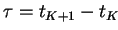
: time step
-- convection matrix
: time step
 : mass matrix
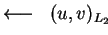

 : diffusion matrix
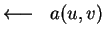

 : convection matrix
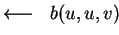
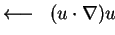
 : gradient matrix
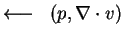

 : divergence matrix
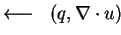

 : velocity vector
 : pressure vector,
then the discretization in space produces a series
of non-linear, non-symmetric and indefinite
systems of equations (
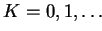 ) :
) :
![$\displaystyle \begin{pmatrix}\tfrac{1}{\tau} M + \sigma \left( D + C(\underline...
...\; \begin{pmatrix}\underline{\widehat{f} \makebox[0pt]{}} \ 0 \end{pmatrix}$](img863.gif) |
(7.4) |
with
![\fbox{
\begin{minipage}[t]{0.9\textwidth}
A non-linear but quasi-linear system ...
...1} &:=& \underline{v}^{n}+\underline{v}_{\delta}
\end{eqnarray*}\end{minipage}}](img865.gif)
This idea changes
 to
to
 in (7.4)
(resulting system is called discrete Oseen equations)
and together with the definition
in (7.4)
(resulting system is called discrete Oseen equations)
and together with the definition
 |
(7.5) |
the fix point iteration can be used for solving (7.4).
![\begin{algorithmus}
% latex2html id marker 29831
[H]
\caption{Linear implicit fi...
...underline{u}^{n+1} \\ \underline{p}^{n+1} \end{pmatrix}
$\\
\end{algorithmus}](img869.gif)
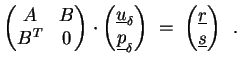
Using the abbreviations
one can write the linear saddle point problem (7.6) in the way
 |
(7.6) |
The description of properties of  follows closely John [Joh97],
pp. 30 :
follows closely John [Joh97],
pp. 30 :
- Stokes (7.3)
 symmetric and positive definite.
- Navier-Stokes (7.2) using stabilization
by means of sharp upwind or
Streamline-Diffusion-Upwind-Petrov-Galerkin (SUPG)
 is regular (i.e.,
 ),
if
),
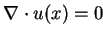
if  fulfills the mass conservation
 .
.
In certain cases (no obtuse-angled triangles in the mesh)
the scheme results in an M-Matrix for extending the set of
applicable solvers considerably.
- Unsteady Navier-Stokes (7.1)
is regular if
the time step
 is small enough (stability of the time scheme).
We use the pressure correction scheme for solving (7.7)
which is in some way similar to the SIMPLE scheme and the Schur-complement
method [Zul97].
Idea :
Factor the block matrix and approximate
submatrices to invert :
with
![$ \widehat{A} \makebox[0pt]{} \approx A$](img884.gif) and
and
![$ \widehat{C} \makebox[0pt]{} \approx B^T A^{-1} B$](img885.gif) approximates the negative Schur-complement.
approximates the negative Schur-complement.
Here and in the following, we denote by
 the spectral equivalence between matrices
  and
and  possessing
the same rank
possessing
the same rank  , i.e, there exist positive constants
 ,
,
 so that
![\begin{algorithmus}
% latex2html id marker 29989
[H]
\caption{Pressure correctio...
...\;=\;& \underline{r} - B \underline{p}_{\delta}
\end{eqnarray}\end{algorithmus}](img891.gif)
Remarks :
- Deleting the third line in algorithm 7.2
results in the preconditioned
Arrow-Hurwicz algorithm
- If one chooses
![$ \widehat{C} \makebox[0pt]{} = \tfrac{1}{\tau} I_{N_p}$](img893.gif) ,
,
![$ \widehat{A} \makebox[0pt]{}=A$](img894.gif) and deletes the third line in
algorithm 7.2 we get the classical
Uzawa algorithm [BF91].
Its iteration matrix is symmetric with respect to a special
chosen inner product.
and deletes the third line in
algorithm 7.2 we get the classical
Uzawa algorithm [BF91].
Its iteration matrix is symmetric with respect to a special
chosen inner product.
- For solving the pressure correction (7.8) as accurate as
possible often the fix point iteration
 |
(7.7) |
is used with
![$ \widetilde{A} \makebox[0pt]{} \approx A$](img897.gif) .
.
Admissible matrices for
![$ \widetilde{A} \makebox[0pt]{}$](img898.gif) :
Identity
:
Identity  ,
mass matrix (non-conform elements),
,
mass matrix (non-conform elements),
 .
.
Possible choices for
![$ \left(B^T \widetilde{A} \makebox[0pt]{}^{-1} B \right)$](img901.gif) :
Identity
:
Identity  ,
mass matrix
,
mass matrix  (diagonal matrix if test functions for the pressure are
constant per element).
(diagonal matrix if test functions for the pressure are
constant per element).
In the symmetric case, the matrix
![$ B^T \widetilde{A} \makebox[0pt]{}^{-1} B$](img904.gif) is
positive semidefinite (i.e., all eigenvalues are greater or
equal 0).
By fixing one component of
is
positive semidefinite (i.e., all eigenvalues are greater or
equal 0).
By fixing one component of
 the related system of
equations (7.9) can be solved via some proper
iteration method (gmres, cg, mg).
Therein, instead of the inverse of
only
the multiplication of that matrix with a vector is needed.
the related system of
equations (7.9) can be solved via some proper
iteration method (gmres, cg, mg).
Therein, instead of the inverse of
only
the multiplication of that matrix with a vector is needed.
- Usually, also
![$ \widehat{A} \makebox[0pt]{}^{-1}$](img906.gif) will be realized via an
iteration method.
will be realized via an
iteration method.
- The fix point iteration (algorithm 7.1) was derived by a
linearization of (7.4) using
On the other hand, the substitution
leads directly to the saddle point problem (7.7)
with the components
which produces the solution
 ,
,
 .
.
If there is a dominating convective part in the differential
equation then this scheme may run into stability problems
(in the time integration)
due to the explicit handling of the convection.
- The stationary Navier-Stokes equations (7.2) are
represented by (7.4) with the components
- The Stokes equations (7.3) are just the
saddle point problem (7.7) with
Matrix is symmetric and positive definite (spd).
![\begin{algorithmus}
% latex2html id marker 30192
[H]
\caption{Sample algorithm f...
...}
\end{minipage}}
\end{minipage}}\\
\mbox{\textbf{\sf od}}
\end{algorithmus}](img916.gif)
Next: 7.1.3 Steps to the
Up: 7.1 Incompressible Navier-Stokes equations
Previous: 7.1.1 Partial differential equations
Contents
Gundolf Haase
2000-03-20

![$\displaystyle \underline{\widehat{f} \makebox[0pt]{}} \;:=\; \sigma \underline{...
...ma) \left( D + C(\underline{u}^{K}) \right)
\right] \underline{u}^K \enspace.
$](img864.gif)


![$\displaystyle \underline{\widehat{f} \makebox[0pt]{}} - A(\underline{u}^n) \underline{u}^n - B\underline{p}^n$](img873.gif)


![$\displaystyle \begin{pmatrix}A & B \ B^T & 0 \end{pmatrix}
\approx
\begin{pm...
...egin{pmatrix}\widehat{A} \makebox[0pt]{} & B \ 0 & I \end{pmatrix} \enspace,
$](img883.gif)

![\begin{algorithmus}
% latex2html id marker 30026
[H]
\caption{Preconditioned Arr...
...a}-\underline{s} \;=\; B^T\underline{u}^{n+1}
\end{eqnarray*}\end{algorithmus}](img892.gif)
![\begin{algorithmus}
% latex2html id marker 30060
[H]
\caption{Preconditioned Uza...
...a}-\underline{s} \;=\; B^T\underline{u}^{n+1}
\end{eqnarray*}\end{algorithmus}](img895.gif)
![$\displaystyle C(\underline{u}^{K+1}) \underline{u}^{K+1}
\quad\xrightarrow[\ma...
...t}]{\mathrm{linear}} \quad C(\underline{u}^{K}) \underline{u}^{K+1} \enspace.
$](img907.gif)
![$\displaystyle C(\underline{u}^{K+1}) \underline{u}^{K+1}
\quad\xrightarrow[\ma...
...}]{\mathrm{convection}} \quad
C(\underline{u}^{K}) \underline{u}^{K} \enspace,
$](img908.gif)
 (spd !)
![$\displaystyle \sigma \underline{f}(t_{K+1}) + (1-\sigma) \underline{f}(t_K)
+ \...
...\tfrac{1}{\tau} M -
(1-\sigma) D - C(\underline{u}^{K}) \right]
\underline{u}^K$](img910.gif)


