![$ u(x,t)\in [C^2(\Omega)\cup C(\overline{\Omega} \makebox[0pt]{})]\times
[C^1((0,T])\cup C([0,T])] \enspace$](img829.gif) ,
so that :
,
so that :
 - vector of velocity, - vector of velocity,
 - pressure (exactly - pressure (exactly
 ), ),
 - force field - force field
 - kinematic viscosity - kinematic viscosity
 - Dirichlet-B.C. - Dirichlet-B.C.
 - initial values. - initial values.
|
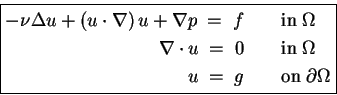
![$ u(x)\in C^2(\Omega)\cup C(\overline{\Omega} \makebox[0pt]{}) \enspace$](img835.gif) ,
so that :
,
so that :
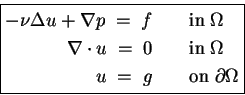
 . The remaining formula is called
Stokes equations
. The remaining formula is called
Stokes equations
 ,
,  and proper test spaces
can be easily derived (see [Joh97],...).
The following discretization via FEM, FVM results in
and proper test spaces
can be easily derived (see [Joh97],...).
The following discretization via FEM, FVM results in
To ensure stability of the discretization
(discrete  -condition),
we use the finite elements introduced in
section 7.1.3.
-condition),
we use the finite elements introduced in
section 7.1.3.
![\begin{equation*}\boxed{ \begin{split}u_t - \nu\Delta u + \left( u\cdot \nabla \...
...0,T]\ u(x) \;=\; u_0(x) & \qquad \text{at} \; t=0 \end{split} }\end{equation*}](img830.gif)