and
and  .
If the number of eigenfrequencies is
.
If the number of eigenfrequencies is  then
this decomposition can be accelerated significantly and is called
Fast Fourier Transformation (FFT).
then
this decomposition can be accelerated significantly and is called
Fast Fourier Transformation (FFT).
|
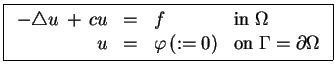
 from the pde in
 .
.
 grid lines in each dimension)
and the differential operator will be approximated by a 5-point difference stencil.
grid lines in each dimension)
and the differential operator will be approximated by a 5-point difference stencil.
![\begin{figure}\unitlength0.08\textwidth
\begin{center}
\begin{picture}(2,2)
\...
...0)[l]{$\scriptstyle h = \tfrac{1}{N}$}}
\end{picture} \end{center}\end{figure}](img775.gif)


![$ \scriptstyle i,j = \overline{1,N-1} \makebox[0pt]{}$](img777.gif)

 from the example above
possesses the eigenfrequencies
from the example above
possesses the eigenfrequencies
![$\displaystyle \mu_{k,\ell}(ih,jh) \;=\; 2 \sin(k\pi i h) \sin(\ell\pi j h)
\qquad{\scriptstyle k,\ell = \overline{1,N-1} \makebox[0pt]{}} $](img780.gif)
![$\displaystyle \lambda_{k,\ell} \;=\; 4
\left[ \sin^2\tfrac{k \pi h}{2} + \sin^2\tfrac{\ell \pi h}{2} \right]
+ c h^2 \enspace.
$](img781.gif)
 and the unknown function can be expressed
as linear combination of the eigenfrequencies.
and the unknown function can be expressed
as linear combination of the eigenfrequencies.
Now, we can achieve the result of the pde as follows :
in terms of eigenfrequencies
 (Fourier analysis)
Determine the
coefficients
(Fourier analysis)
Determine the
coefficients
 in (6.7a).
 inversion of operator)

 in (6.7b)