Next: 6.4 FFT
Up: 6.3 Gauß elimination of
Previous: 6.3 Gauß elimination of
Contents
6.3.1 Parallelization by means of cyclic reduction
Cyclic reduction :
Rearranging the equations and unknowns in such a manner that
several unknowns can be eliminated at the same
time, i.e., in parallel.
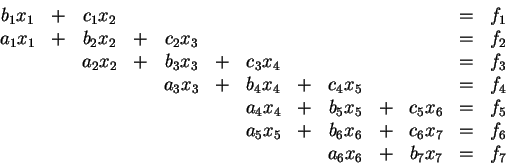
Basic idea of rearrangement for
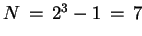 unknowns
Eliminate all  with
with
 from the system :

![\begin{displaymath}\begin{array}[t]{ccccccc}
\widetilde{b} \makebox[0pt]{}_2 x_...
...t]{}_6 x_6 &=& \widetilde{f} \makebox[0pt]{}_3 \\
\end{array}\end{displaymath}](img762.gif)
Eliminate all with

![$ \widehat{b} \makebox[0pt]{}_4 x_4 = \widehat{f} \makebox[0pt]{}_4$](img764.gif)
Generally :
![\fbox{\begin{minipage}[t]{0.6\textwidth}
Elimination sequence : $2^{k-1} \le n <...
...qquad Eliminate all $x_i$ with $i \mod 2^{j+1} = 2^j$\\
END DO
\end{minipage}}](img765.gif)
Figure 6.6:
Matrix and elimination tree after rearranging by cyclic reduction.
The  -entries denote additional fill-ins.
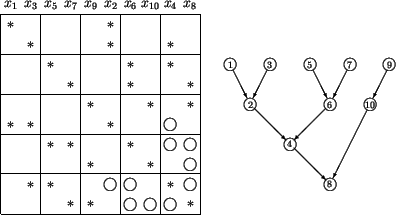 |
The elimination tree and the cyclic reduction presented in Fig. 6.6
- requires twice as much arithmetic as the normal
Gauß elimination, but
- It can be parallelized.
- A sequential rearrangement to reduce the fill-in has no meaning at all
for the parallel run.
Remark :
There exists no special concept for the parallelization of direct solvers
for sparse matrices !
Next: 6.4 FFT
Up: 6.3 Gauß elimination of
Previous: 6.3 Gauß elimination of
Contents
Gundolf Haase
2000-03-20