| ||||||||||||||||
![\begin{figure}\begin{center}
\unitlength0.05\textwidth
\begin{picture}(8,6)
\...
...b]{yes}} \put(6,4.2){\makebox(0,0)[b]{no}}
\end{picture}\end{center}\end{figure}](img40.gif)
![\begin{figure}[H]
\begin{minipage}[t]{0.45\textwidth}
If the test ''?'' result...
...} \put(9.2,0.5){\makebox(0,0)[l]{t}}
\end{picture}
\end{minipage} \end{figure}](img41.gif)
 data sets.
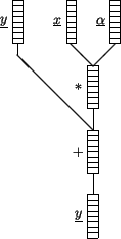
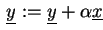
A typical operation is the SAXPY-routine
data sets.
A typical operation is the SAXPY-routine
 ,
see Fig. 2.1 where
a vector
,
see Fig. 2.1 where
a vector
 will be scaled by a scalar and added to
a
will be scaled by a scalar and added to
a
 .
Here, the pipelining consists in loading operands,
multiplication, addition and storing of the result. All these
operations will be executed on special vector registers.
After a startup phase, the vector unit produces one component of
the result per clock although the sequential/scalar
execution would require
much more clocks.
.
Here, the pipelining consists in loading operands,
multiplication, addition and storing of the result. All these
operations will be executed on special vector registers.
After a startup phase, the vector unit produces one component of
the result per clock although the sequential/scalar
execution would require
much more clocks.
 appearing in Fig. 2.1
is just a filling of the vector pipe with the constant scalar
appearing in Fig. 2.1
is just a filling of the vector pipe with the constant scalar  .
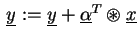
This will be done automatically by the compiler to handle
.
This will be done automatically by the compiler to handle
 efficiently.
![\unitlength0.03\textwidth
\mbox{}\hfill
%% begin\{picture\}(5,12)
% Box [-1,1]x[...
...(Theorem of conservation of difficulties)
\end{minipage}\hfill\mbox{}\ [1ex]
%](img50.gif)
 Class SPMD is a sub-class of MIMD