


Next: 5.4.4.1 Variant 1 : formal
Up: 5.4 Gauß-Seidel iteration
Previous: 5.4.3 Red-Black-Gauß-Seidel iteration
Contents
5.4.4 Parallel algorithms
The update step of the Gauß-Seidel iteration is the significant
difference to the Jacobi iteration so we restrict our further
investigations on it.
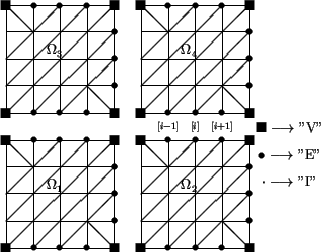
A data distribution with non-overlapping elements (Sec. 4.3.1)
is assumed and represented in Fig. 5.4.
Figure 5.4:
Domain decomposition of unit square
 |
A formal application of the parallelization strategy
used for the  -Jacobi iteration results in a distributed
matrix
-Jacobi iteration results in a distributed
matrix
 , an accumulated diagonal matrix
 ,
distributed stored vectors
,
distributed stored vectors
 ,
,
 and accumulated vectors
 ,
,
 .
In difference to the Jacobi iteration we have to
investigate various opportunities for choosing an efficient
parallel algorithm.
.
In difference to the Jacobi iteration we have to
investigate various opportunities for choosing an efficient
parallel algorithm.
Subsections
Gundolf Haase
2000-03-20