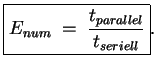
processors
accelerates the code by a factor of .
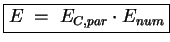
The parallel efficiency for the scaleup can be given explicitely :
processors
accelerates the code by a factor of .
The parallel efficiency for the scaleup can be given explicitely :

 Slightly decreasing efficiency with increasing
number of processors.
Efficiency is however at least as high as the
parallel part of the program. Lecture continuation makes sense.
Slightly decreasing efficiency with increasing
number of processors.
Efficiency is however at least as high as the
parallel part of the program. Lecture continuation makes sense.
|
Formula (3.4) assumes a uniform distribution of the total task on
all processors.
In practice this often cannot be hold
or is not fulfilled during the calculations.
At the same time, formula (3.4) does not include any losses
due to communication.
Attained efficiency is lower than theoretical.
|
 The better the desired data distribution should be (also regarding
communication), the more expensive are the
individual bisection techniques.
Especially suited for optimization problems,
distribution of coarse meshes/grids in multigrid algorithms.
The better the desired data distribution should be (also regarding
communication), the more expensive are the
individual bisection techniques.
Especially suited for optimization problems,
distribution of coarse meshes/grids in multigrid algorithms.