


 - system time of process A on one processor - system time of process A on one processor
 - system time of process A on - system time of process A on  processors processors
|
is desirable, i.e., processes are times faster than one.
 of the problem which have to be solved remains
constant.
of the problem which have to be solved remains
constant.
![$\displaystyle
N_{ges} = \text{const.}\;\;\;\Longrightarrow\;\;\;
N_i \sim \frac{1}{P}\;\;\forall i=\overline{1,P} \makebox[0pt]{}\enspace,
$](img229.gif)
 worker digs a pit of
  [] in
[] in  .
How long [] does it take
.
How long [] does it take  workers to perform the same work ?
 The workers obstruct themselves mutually, a too high organization
overhead is necessary.
The workers obstruct themselves mutually, a too high organization
overhead is necessary.
 very little speedup.
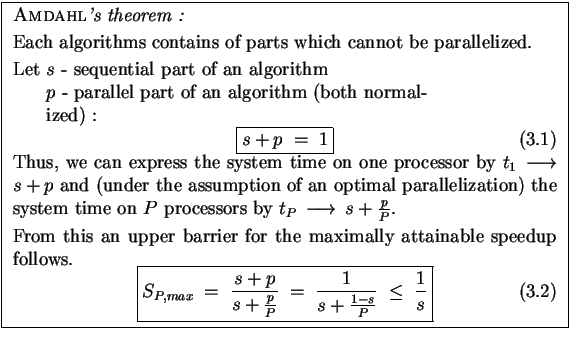
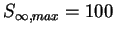
|
10 | 100 | 1000 | 10000 |
 |
9 | 50 | 91 | 99 |
Discouraging
End of lecture ?
on smaller processor numbers ( ) !
This is caused by a more intensive use of cache memory on the
processors if the size of the local problem is getting smaller.
, then 1000 workers reach nearly a
1000 times higher performance during that hour. They all work
on one huge project.
) !
This is caused by a more intensive use of cache memory on the
processors if the size of the local problem is getting smaller.
, then 1000 workers reach nearly a
1000 times higher performance during that hour. They all work
on one huge project.
 (
( )) and introducing
the notations
)) and introducing
the notations
 - system time on a parallel computer
 - system time on a sequential computer
 (Gaußelimination)
  (pcg=preconditioned cg)
 (Gaußelimination)
  (pcg) !!


![\begin{figure}\protect\includegraphics[width=\textwidth]{pester.ps}
\end{figure}](img246.gif)