variables:

 - value (integer)
Queue - value (integer)
Queue
|
and operations ( init):
 roberen roberen  WAIT WAIT
 erhogen SIGNAL erhogen SIGNAL
|
and
are atomic.
The operations are linked with the variables as follows :
|
(s): |
-value  0 0 |
 |
process in queue [train on the line] | |||
-value  0 0 |
|
(
-value) and
resources are available and
resources are available |
||||
| [empty line, enter it and set signal on ''red''] | ||||||
|
(s) |
queue is empty |
|
(
-value) [set signal on ''green'']
 |
|||
| queue not empty |
|
activate a (waiting) process | ||||
| [let one stopped train enter the line, signal remains on ''red''] |
(s) will be done only once per process,
therefore the queue is necessary.  ,
,  )
semaphore
)
semaphore
 INIT(
) is required,
otherwise deadlock appears.
INIT(
) is required,
otherwise deadlock appears.
 Resources
The result is unique (
 ) !!
) !!
 then the number of possible responses is
only reduced from 4 to 2.
This happens for A:
then the number of possible responses is
only reduced from 4 to 2.
This happens for A:
 and B:
  .
.
|
A
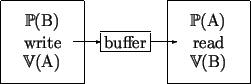
represents a full buffer;
INIT(A) with 0
B represents an empty buffer;
INIT(A) with 1
|
 -Gauß-Seidel iteration
(forward) if a 5-point-stencil was used for the discretization of
the Laplace problem.
-Gauß-Seidel iteration
(forward) if a 5-point-stencil was used for the discretization of
the Laplace problem.
![\begin{displaymath}
\widehat{c} \makebox[0pt]{}_{i,j} \;:=\; c_{i,j} +
\left(...
...-1} + 4 c_{i,j} - c_{i+1,j} - c_{i,j+1} \right]
}\right) / 4
\end{displaymath}](img163.gif)
![$ \widehat{c} \makebox[0pt]{}_{i,j}$](img131.gif) is the consumer and all remaining variables are
producers (even
is the consumer and all remaining variables are
producers (even
![$ \widehat{c} \makebox[0pt]{}_{i-1,j}$](img129.gif) and
and
![$ \widehat{c} \makebox[0pt]{}_{i,j-1}$](img130.gif) !!).
See also Sec. 3.1.
!!).
See also Sec. 3.1.

 procedure test (integer value k);
   if C[(k-1) mod 5] <> 2   and   C[k] == 1
                            and   C[(k+1) mod 5] <> 2
      begin  C[k] := 2,  V(prisem[k])  end
 end
Remark :
![$C[k] \;=\; \begin{cases}0 & \qquad\text{vacant seat} \\
1 & \qquad\text{occup...
...sopher} \\
2 & \qquad\text{occupied seat, 2 forks in hands} \\
\end{cases} $](img164.gif)
![$ prisem[k] == 1 \;\;\;$](img165.gif) philosopher
philosopher  may start eating. the above procedure consists in the queries
he does not eat)
takes the 2 forks and starts to eat.
may start eating. the above procedure consists in the queries
he does not eat)
takes the 2 forks and starts to eat.
 ):
):
 1:     cycle begin  think
 2:                  P(mutex)
 3:                    C[w] := 1;  test(w)
 4:                  V(mutex)
 5:                  P(prisem[w]);  eat
 6:                  P(mutex)
 7:                    C[w] := 0;  test[(w+1) mod 5];
                                   test[(w-1) mod 5]
 8:                  V(mutex)
 9:           end
Explanation:
![\begin{figure}\unitlength0.05\textwidth
\begin{picture}(18,5)
\put(0,0){\line(...
...t(5,1){\vector(4,3){3.2}}
\thinlines %
\par\end{picture}\ [0.5ex] \end{figure}](img158.gif)