


Next: 3.2.2.1 Concept of semaphores
Up: 3.2 Synchronization of parallel
Previous: 3.2.1 Some definitions
Contents
3.2.2 Semaphores
A general problem with the access to shared resources consists in the
prevention of deadlocks.
Deadlock :
Several processes are waiting for an event which can be
released only by one of these waiting processes (blocking).
Ex.: Dinner for five [Dijkstra, 1971]
-
Figure 3.5:
Dinner for five
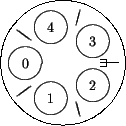 |
''The life of the philosophers consists of alternating activities
thinking and eating.
Each philosopher has its seat at the table.
Their only problem - apart from those philosophical nature - consists
of the fact that the served meal is a very difficult type of spaghetti, for
which consumption one needs two forks.
Next to each plate 2 forks are situated, so that basically no
difficulties should occur. It has however as a consequence that
2 neighbors cannot eat at the same time.`` [Rec94]
(re-translation from German)
The 5 forks are representate the lack of resources in a large system.
Solution (Instruction) 1:
- If you are hungry then occupy a vacant seat.
- Wait until the left fork is available and take it.
- Wait until the right fork is available and take it.
- Eat your spaghetti.
- Release both forks after the meal !
 Deadlock :
All philosophers will die by hunger with a fork in their left hand.
Solution 2:
- If you are hungry then occupy a vacant seat.
- Wait until the left and right fork are available and take it.
- Eat your spaghetti.
- Release both forks after the meal !
''Deadlock for all'' is impossible, but a
single philosopher is threatened by hunger death,
e.g., this happens for philosopher no.1, if no.0 and no.2
eat alternatively but with a small overlapp in time.
Dijkstra's suggestion :
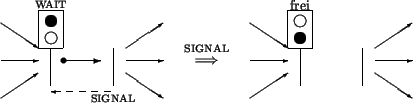
Definition of semaphores (a semaphore is a signal of the
Dutch railway company).
Semaphore :
A signal, which is operated by individual processes and not by a
central instance (Fig. 3.6).
The process [train] waits if the signal is on ''WAIT'' [red].
Otherwise, the access [entry] on the critical range [railroad line]
is released and that process [train] places the signal on
''WAIT'' [red] for all other processes [trains].
Figure 3.6:
Release of a semaphore
 |
- Shared Memory
 semaphores
- Distributed Memory
message passing model
communication
Subsections
Next: 3.2.2.1 Concept of semaphores
Up: 3.2 Synchronization of parallel
Previous: 3.2.1 Some definitions
Contents
Gundolf Haase
2000-03-20