Next: 6.2 LU factorization
Up: 6.1 Elimination by rotation
Previous: 6.1.2 Givens rotation on
Contents
6.1.3 Givens rotation on a parallel computer
Denote by  the Givens rotation of rows
  and
and  in column
  .
.
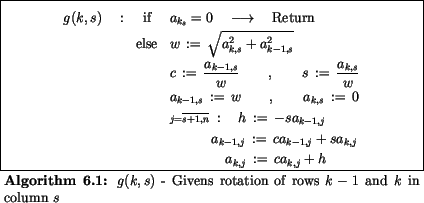
The following data dependencies occur :
Figure 6.1:
Static data dependencies in the Givens rotation
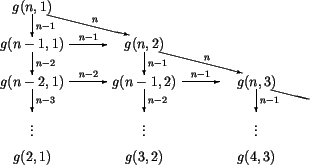 |
We transform the static data dependency in Fig. 6.1 by means
of markers  into a dynamic data flow chart
with an arbitrary number of processors.
into a dynamic data flow chart
with an arbitrary number of processors.
Let  the number of markers for process .

 process starts.
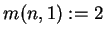
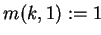
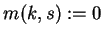
Initial values :
On a shared memory computer, we achieve the flow chart in Fig. 6.2
Figure 6.2:
Flow chart on a shared memory computer : Givens rotation
|
The markers  and
and
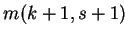 are incremented after
process has finished.
are incremented after
process has finished.
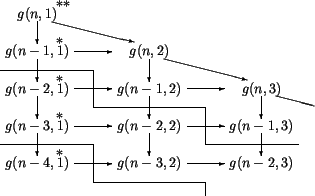
If the processors have only access on a part of the distributed memory
then we have to investigate the data dependencies between the processors.
Here, a rowise distribution of blocks of matrix  is preferred, see Fig. 6.3.
Figure 6.3:
Flow chart on a distributed memory computer: Givens rotation
 |
Remark : A similar distribution of rows can also be uses in the
Gauß elimination.
Next: 6.2 LU factorization
Up: 6.1 Elimination by rotation
Previous: 6.1.2 Givens rotation on
Contents
Gundolf Haase
2000-03-20