


 requires two vector type conversions (Sec. 4.3.1).
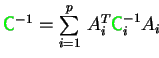
That preconditioner can be written as :
requires two vector type conversions (Sec. 4.3.1).
That preconditioner can be written as :
 is not accumulated and therefore the
submatrices
is not accumulated and therefore the
submatrices
 represent a 2
 order
pdes in
order
pdes in  with homogeneous Neumann boundary conditions on
the inner boundaries
(interfaces)
with homogeneous Neumann boundary conditions on
the inner boundaries
(interfaces)
 .
This leads in the case of the Laplace operator to singular
submatrices
.
.
This leads in the case of the Laplace operator to singular
submatrices
.
On the other hand we may choose
 in a different way.
One opportunity consists in the accumulation of matrix
in a different way.
One opportunity consists in the accumulation of matrix
 and
the setting
and
the setting
 .
The local preconditioner
represents a 2
order pde in
.
The local preconditioner
represents a 2
order pde in
 with homogeneous Dirichlet boundary conditions.
Here,
denotes extended by the next layer
of surrounding elements.
Thus, this preconditioner is a overlapping one,
for further details see [SBG96] or the patch-by-patch method.
with homogeneous Dirichlet boundary conditions.
Here,
denotes extended by the next layer
of surrounding elements.
Thus, this preconditioner is a overlapping one,
for further details see [SBG96] or the patch-by-patch method.
