(
(
![$ \scriptstyle q=\overline{1,\ell} \makebox[0pt]{}$](img638.gif) ) where the finer grid
) where the finer grid
 was derived from the coarser one
 (simplest case in 2D: subdivide all triangles in 4 congruent ones).
For that hierarchy of grids the relation
(simplest case in 2D: subdivide all triangles in 4 congruent ones).
For that hierarchy of grids the relation
 should hold, i.e., the grids are nested.
Discretizing the given differential equation on each
grid
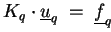
results in a series of systems of equations
 .
.
When analyzing the (non-optimal) convergence behavior of
iteration methods presented in Sec 5.3 and 5.4
by means of representing the error
 as sum of the
eigenfrequencies of matrix
as sum of the
eigenfrequencies of matrix  we achieve the following results :

 at low costs without losing the good convergence behavior
for the high frequency errors
at low costs without losing the good convergence behavior
for the high frequency errors
 .
on grid
.
on grid
 (smoothing),
project the remaining error onto coarse
grid
(smoothing),
project the remaining error onto coarse
grid
 and solve there exactly.
Interpolate the coarse grid solution (named defect correction)
back to the fine grid
and add it to the
solution thereon.
Usually an additional smoothing reduces the high frequency errors
once more.
and solve there exactly.
Interpolate the coarse grid solution (named defect correction)
back to the fine grid
and add it to the
solution thereon.
Usually an additional smoothing reduces the high frequency errors
once more.
 recursively by a two grid
method until the coarsest grid
recursively by a two grid
method until the coarsest grid
 is reached.
There, we have to solve the remaining small system of equations
exactly.
is reached.
There, we have to solve the remaining small system of equations
exactly.