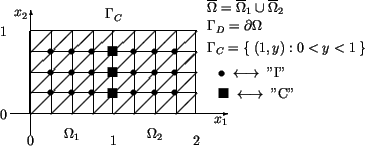
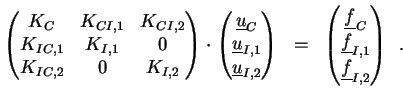
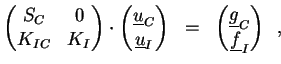
The distribution of the FE-node in Fig. 5.5 implies a block structure in the system of equations (5.1) :
 |
 |
 |
(5.8) |
|
 |
||
 | |||
 |
|
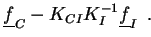 |
|
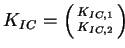 and
and
 are block matrices.
The matrix
are block matrices.
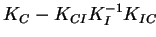
The matrix  is in general fully occupied -
the Schur complement can be given explicitly in special cases.
is in general fully occupied -
the Schur complement can be given explicitly in special cases.
The main advantage of system (5.7) consists in
the fact that due to the block structure of  the inversion
of the local matrices
the inversion
of the local matrices  and
and  can be done
successively on each super element.
Therefore it possible by means of storing unused data on disc
to solve problems which would otherwise exceed the main memory.
This was used intensively in the 60/70-ies by engineers
and is well-known as Element-by-Element method (EBE).
can be done
successively on each super element.
Therefore it possible by means of storing unused data on disc
to solve problems which would otherwise exceed the main memory.
This was used intensively in the 60/70-ies by engineers
and is well-known as Element-by-Element method (EBE).
![\begin{algorithmus}
% latex2html id marker 23915
[H]\caption{Element-by-Element ...
... \\
&\multicolumn{3}{l}{\mbox{\textbf{\sf end}}}
\end{array}$\end{algorithmus}](img632.gif)
Because of the expensive inversion of the Schur complement
(no more a sparse matrix) the system in II) will be often solved
by means of an iteration method.
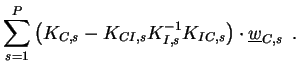
The great advantage is that we need therein only
matrix-times-vector multiplications with the Schur complement on
the super elements :
 |
 |
 |
|
|
 |
 will be done in each
super element by a LU- or Cholesky-factorization so that in the
following the application of consists only in
the elimination steps.
will be done in each
super element by a LU- or Cholesky-factorization so that in the
following the application of consists only in
the elimination steps.