


 ).
At the end, the result is available on one root process
(Reduce operation) or on all processes (All-Reduce).
).
At the end, the result is available on one root process
(Reduce operation) or on all processes (All-Reduce).
 Reduce : We use the tree topologie with root
  .
.
 ,
,
 ,
,
 ,
,

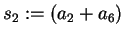 ,
,
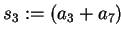
![$ s_1 := [(a_1+a_5)+(a_3+a_7)]$](img200.gif)
![$ s_0 := [(a_0+a_4)+(a_2+a_6)] + [(a_1+a_5) + (a_3+a_7)]
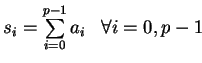
= \sum\limits_{i=0}^{p-1} a_i$](img201.gif)
 possesses the correct result, all other
processes have only partial results at the end.
possesses the correct result, all other
processes have only partial results at the end.  ,
, ,
, ,
, ,
, ),
which can also handle vectors and operations on them
in the parameter list
(in example above the call is :
CALL Tree_UpDo(1,S,A,AuxArray,VdPlus)).
All-Reduce
),
which can also handle vectors and operations on them
in the parameter list
(in example above the call is :
CALL Tree_UpDo(1,S,A,AuxArray,VdPlus)).
All-Reduce

![$ s_0 = [(a_0+a_4)+(a_2+a_6)] + [(a_1+a_5)+(a_3+a_7)]$](img208.gif)

![$ s_7 = [(a_0+a_4)+(a_2+a_6)] + [(a_1+a_5)+(a_3+a_7)]$](img210.gif)

 |

| CUBE/SMALL>_DO | TREE/SMALL>_DO | ||
|
equivalent arithmetical costs | ||
|
nCube bi-directional communications or
2 nCube uni-directional communications nCube uni-directional communications |
2nCube uni-directional communications |
|
|
same bandwidth on all links required | decreasing bandwith required with increasing/decreasing link number | |
|
best choice if all links have the same bandwidth Ideal bei gleicher Bandbreite aller Links | Selection of the tree embedded in the hypercube with respect to the bandwidth of the links | |
|
best in a physical hypercube, e,g, NCUBE2 | With larger systems technologically caused smaller bandwidths can occur on some links, e.g., POWER-GC | |
| Links 1-4 | : | bandwidth  |
| Links 5-6 | : | bandwidth  |
| Links 7-8 | : | bandwidth  |
 .
Since the higher links have a smaller bandwidth, they should
be used with the TREE/SMALL>_.. operation in the optimal tree close
to the root process. There only a few processes have to
communicate to each other.
.
Since the higher links have a smaller bandwidth, they should
be used with the TREE/SMALL>_.. operation in the optimal tree close
to the root process. There only a few processes have to
communicate to each other.
 communication time) of the accordingly chosen TREE/SMALL>_DO
routines in relation to the equivalent CUBE/SMALL>_DO routines.
communication time) of the accordingly chosen TREE/SMALL>_DO
routines in relation to the equivalent CUBE/SMALL>_DO routines.
Change algorithm for TREE/SMALL>_DOWN at
page ![[*]](file:/usr/local/lib/latex2html/icons/crossref.gif) such that links with larger numbers
transport as little data as possible. such that links with larger numbers
transport as little data as possible. |
![\begin{figure}\unitlength0.04\textwidth
\begin{center}
\begin{picture}(14,9)(0...
...5}} \put(5.9,8.4){\makebox(0,0)[bl]{c)}}
\end{picture} \end{center} \end{figure}](img193.gif)
![\begin{figure}\unitlength0.04\textwidth
\begin{center}
\begin{picture}(11,11)
...
...akebox(0,0)[br]{$\scriptstyle a)$}}
%
\par\end{picture}\end{center}\end{figure}](img207.gif)